

You hear rushing water where there should not be any. A burst pipe can push hundreds of litres through your home in under an hour, so the next ten minutes matter more than anything that comes after. Turn off the mains water first. If water is anywhere near power points, lights, or appliances, kill the electricity at the switchboard. Then call an emergency plumber Sydney.
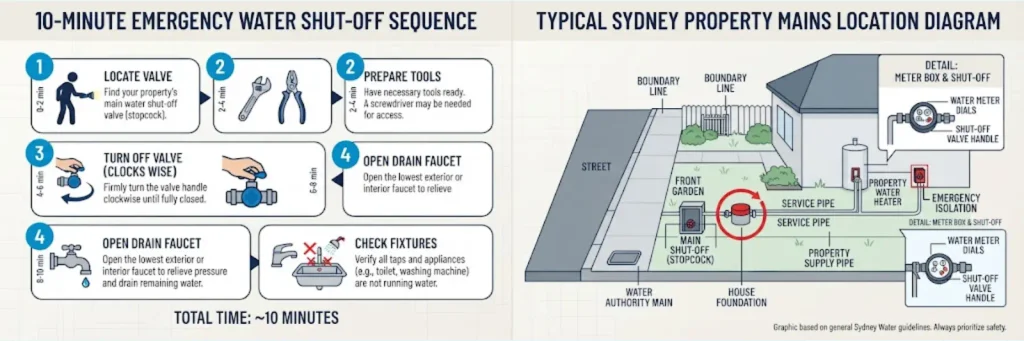
Everything else, finding the leak, moving your belongings, documenting the damage, fits into the minutes in between. Here is the full sequence.
Minute 1: Turn Off the Mains Water
Every second the mains stays on, more water enters the house. Finding the shut-off valve is the single most important thing you can do.
Where to look:
- Front of the property near the meter. In most Sydney homes, the mains shut-off valve sits next to the water meter, usually in a small pit or box near the front boundary. Turn it clockwise until it stops.
- Inside the house. Some homes, particularly units and apartments, have an isolation valve under the kitchen sink, in the laundry, or inside a service cupboard.
If you cannot find the valve or it will not turn, open the lowest tap in the house (usually the garden tap or laundry tub) to relieve pressure and slow the flow while you wait for a plumber.
Tip you will thank yourself for later: Go and check where your mains shut-off is right now, today, while everything is dry and calm. Trying to find it with water running across the floor is a different experience entirely.
Minute 2: Cut the Power if Water Is Near Electricals
Water and electricity are a dangerous combination. If the burst has sent water into a room with power points, light fittings, or appliances, go to the switchboard and turn off the circuit for that area. If you are unsure which circuit covers the affected room, switch off the main breaker.
Do not touch any electrical appliance or power point that is wet or sitting in water. If the switchboard itself is in a flooded area, stay clear and call your electricity provider’s emergency line as well as a plumber.
Minute 3: Find the Leak and Move Valuables
With the water off and the power safe, locate the burst. Common places include:
- Under sinks (flexi-hose connections are a frequent failure point in Australian homes)
- Inside wall cavities (you may hear dripping or see a bulging wall)
- In the ceiling space (water stains or sagging plasterboard)
- At the hot water system (pressure relief valve or corroded fittings)
You do not need to fix anything at this stage. Just identify where the water is coming from so you can tell the plumber when they arrive. While you are there, move electronics, documents, rugs, and anything sitting on the floor to a dry room.
Minutes 4 to 10: Slow the Water, Protect the Floor, Document Everything
Contain what you can. Use towels, buckets, or bins to catch active drips. If water is pooling on a hard floor, a squeegee or mop will help direct it toward a drain or the front door. Open internal doors to prevent water pooling against them and warping the frames.
Do not start a full cleanup yet. Before you mop up, photograph and video the damage. Walk through every affected room and record what you see, including:
- Where the water is coming from
- Which rooms, walls, and floors are wet
- Any damaged belongings, furniture, or fittings
- The water level at its highest point (look for a tide mark on walls or skirting)
These photos are critical for your insurance claim. Take them before you start drying or moving things, not after.
Call a licensed plumber. Once the water is off, the power is safe, and you have your photos, call a plumber. A burst pipe is an emergency job, and a licensed plumber Sydney team can attend the same day to isolate, repair, or replace the damaged section.
What Not to Do
A few common mistakes can make the situation worse or complicate your insurance claim.
- Do not turn the mains back on to check whether the leak has stopped. If the pipe has split, the water will start again the moment pressure returns.
- Do not walk through standing water with the power on. Even shallow water can conduct electricity from a submerged power point or appliance cord.
- Do not clean up before taking photos. Your insurer needs to see the damage as it was, not after you have mopped and dried everything. The same applies to damaged items. Keep them until the assessor has seen them or confirmed you can dispose of them.
- Do not attempt to solder, glue, or clamp a burst section yourself. A temporary repair that fails overnight can cause far more damage than waiting for a licensed plumber. In NSW, plumbing work on pressurised water lines must be carried out by a licensed tradesperson.
What Insurance Usually Covers and What It Does Not
This is general guidance only, not legal or financial advice. Every policy is different, so check yours.
Most standard home and contents insurance policies in Australia cover the resultant damage from a burst pipe. That means the water damage to your floors, walls, ceilings, and belongings. According to QBE Insurance research, burst or blocked pipes account for 46 per cent of all home water damage claims in Australia (source: QBE Insurance, 2024).
What is often not covered is the pipe repair itself. Insurers typically classify the pipe as a maintenance item, meaning the plumbing repair comes out of your pocket while the water damage to the property is handled by the policy.
Things that help your claim:
- Photos and video taken before cleanup (as described above)
- A written report from the plumber identifying the cause of the burst
- Receipts for any emergency cleanup or accommodation costs
- Evidence that you took reasonable steps to minimise the damage (turning off the mains, moving valuables)
If your property is in a flood-prone area, it is also worth understanding your broader exposure. 1 in 6 Australian homes is at flood risk, and a burst pipe during a storm can compound the problem significantly. Our flood prevention page covers what can be done to reduce that risk before it arrives.
FAQs and Tips
Where is the mains water shut-off valve in a typical Sydney house?
In most freestanding homes, it is in a small pit near the front property boundary, next to the water meter. In units and apartments, look for an isolation valve under the kitchen sink or in a common-area riser cupboard. If you rent, ask your property manager to confirm.
How quickly can a burst pipe cause serious damage?
A single burst connection can release several hundred litres per hour. In an open-plan home, water can reach multiple rooms within minutes. Suncorp data from 2025 found that one in ten home water damage claims were caused by burst flexi-hose connections alone (source: Suncorp, 2025).
Should I turn off the hot water system as well?
If the burst is on a hot water line, yes. Switch the system off at its isolating valve (and at the power point or gas supply if accessible). This prevents the unit from dry-firing once the water supply is cut.
Can I prevent burst pipes?
You cannot eliminate the risk, but you can reduce it. Have flexi-hose connections inspected and replaced every five to ten years. Check visible pipework for corrosion or green staining on copper joints. And know where your mains shut-off is before you need it. A routine check as part of your general plumbing services schedule will catch most issues early.
What if water is coming up through the floor drain instead of from a pipe?
That is usually a blocked or overloaded drainage line rather than a burst supply pipe. The response is different, and the cause may be external. Our emergency plumber team can diagnose both on the same call-out.
Sigma Plumbing is a licensed, Sydney-based plumbing company serving homeowners, businesses, and strata properties across Western Sydney and Greater Sydney. If a pipe has burst in your home, call us on 0426 582 778 or visit sigmaplumbing.com.au for 24/7 emergency plumbing.